Question How did Marco Solutions Drones come about?
The project grew out of my 30-year career as a professional firefighter. Throughout that time I learned to work with rigour, stay calm under pressure, take on responsibility and, above all, look for solutions to protect people and anything of value.
I also had the chance to get to know buildings very closely: their structures, materials and weak points. I saw deteriorated roofs, weakened façades, and buildings or monuments that could have been preserved far better with proper preventive maintenance.
For a firefighter, prevention is part of the job. We don't wait for something to catch fire before acting. That is the same philosophy I wanted to bring to the maintenance of heritage and buildings.
When I discovered what drones could do for cleaning and maintenance, I saw an opportunity. They make it possible to reach difficult areas, work with precision and, above all, considerably reduce people's exposure to work at height.
I trained, obtained the necessary certifications, specialised in surface treatment techniques, and Marco Solutions Drones was born. After 30 years of public service, I simply found a new tool to keep being useful and solving problems.
Question Was the project already focused on drone cleaning from the start?
Yes, it was born with that philosophy. I didn't come to the world of drones simply out of a passion for technology. For me, the drone is a tool. What matters is the problem we want to solve and finding the safest and most effective way to do it.
Our work is not just about flying a drone in front of a façade. We combine technology, suitable products, knowledge of surfaces and operator experience.
In addition, when necessary, we use telescopic carbon poles that can reach up to 20 metres. Technology is important, but the real value lies in knowing how to use it and when it is truly the right solution.
Question Where do you operate from?
Our activity is organised in a very flexible way. We travel directly to our clients' sites depending on the characteristics of each project.
This allows us to work on site and adapt to each building, installation or surface.
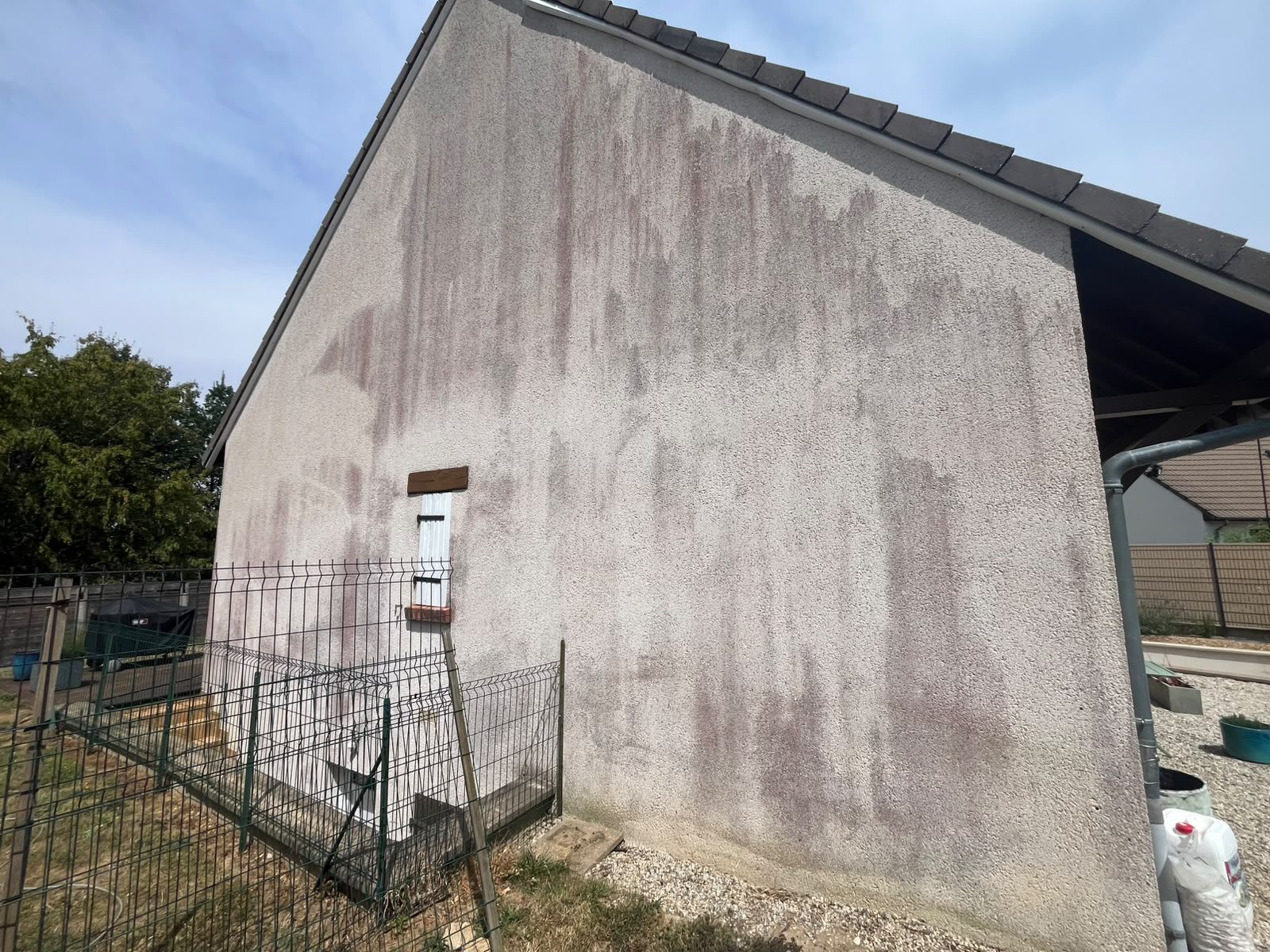
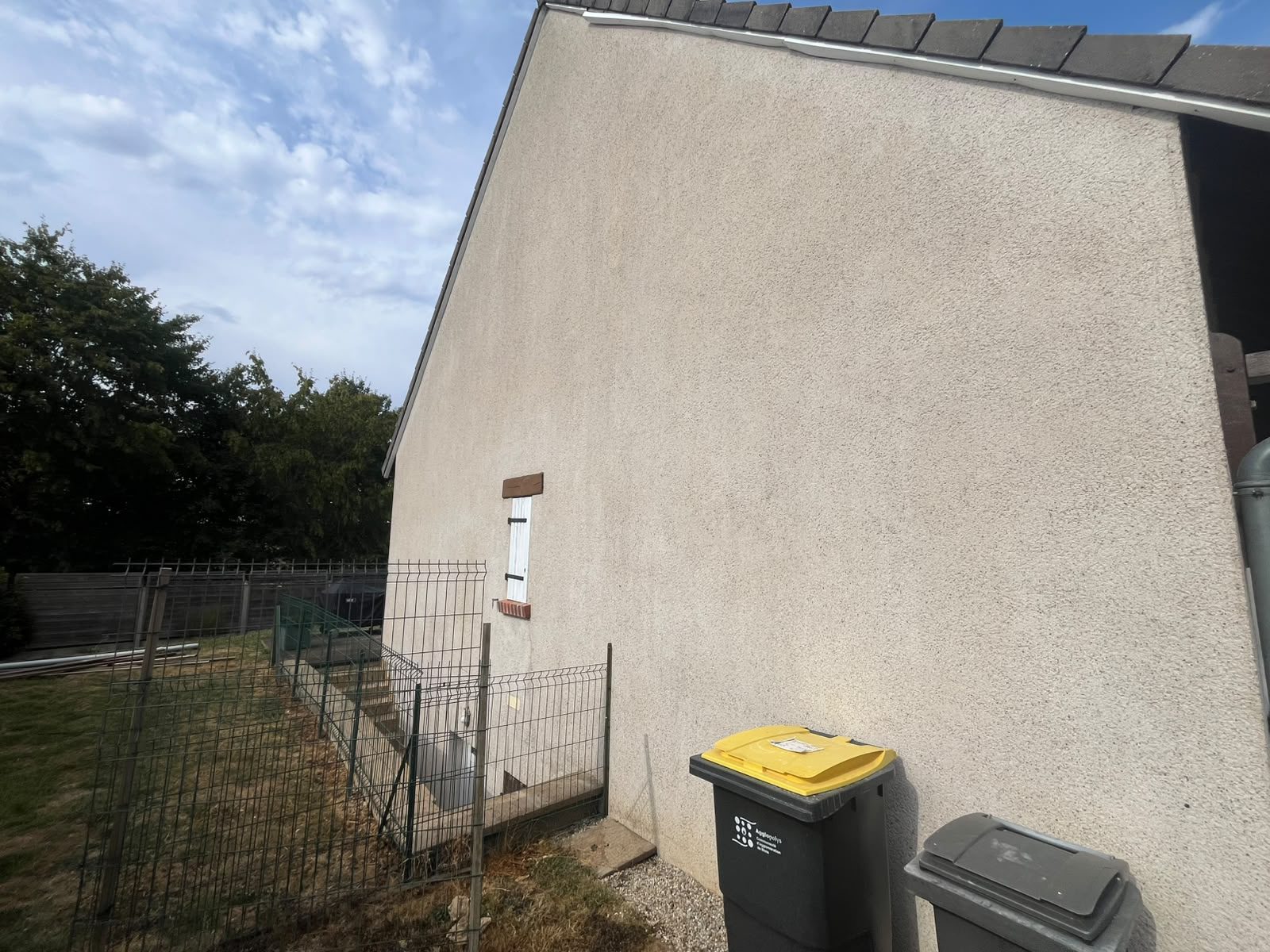
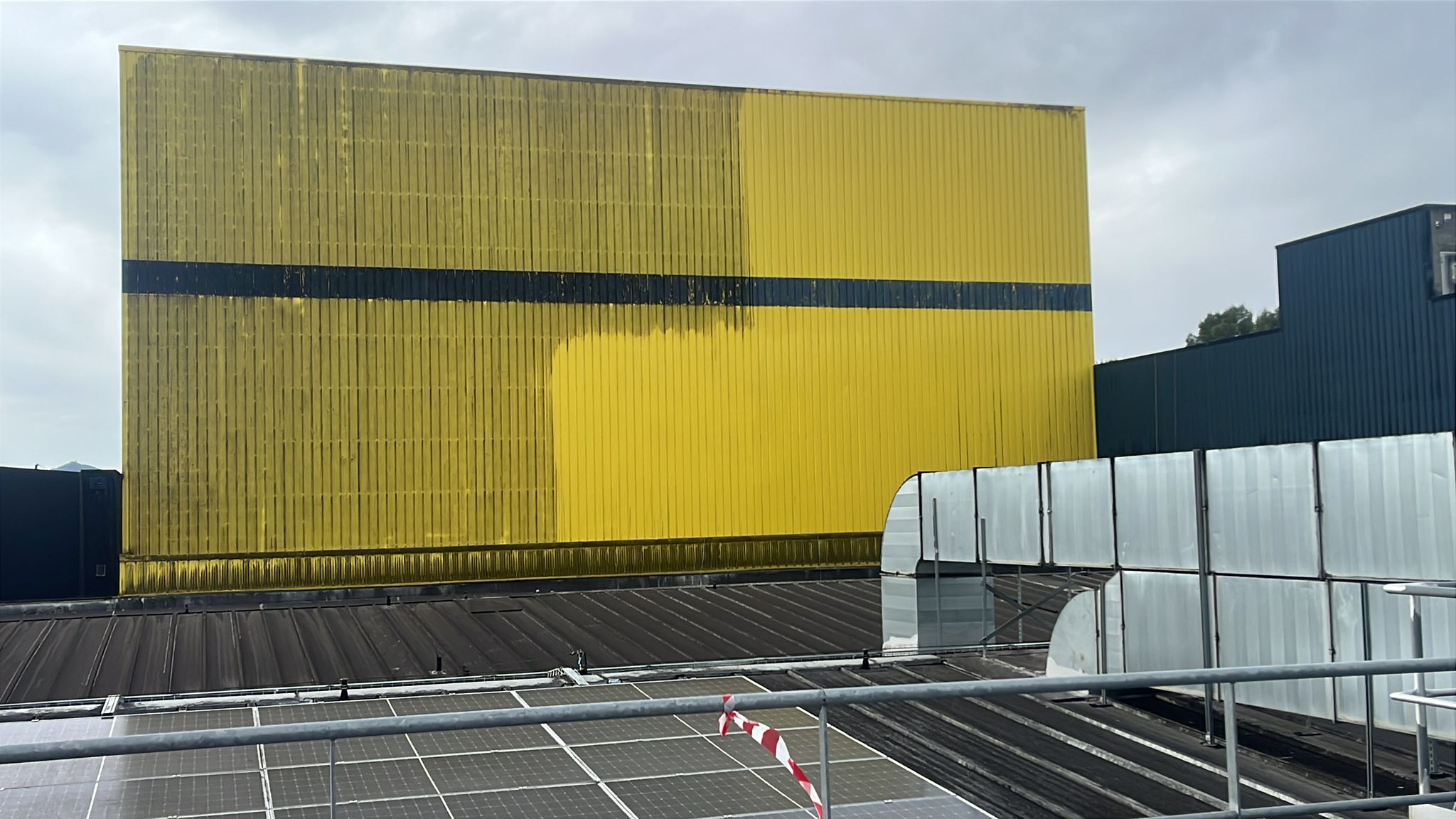
In the photograph, the façade before and after cleaning
Question Can you work throughout Spain?
Yes, our aim is to be able to carry out work in different areas of Spain.
That said, drone activity is subject to the authorisations and regulations applicable to each operation, so every job is assessed individually.
Question What kinds of clients do you have?
Very different ones. We work with private individuals, homeowners' associations, residential care homes, town councils, public buildings, industrial companies, logistics facilities, warehouses, shopping centres, silos and large installations.
We can also work at particularly sensitive or complex sites, such as Seveso industrial facilities and nuclear power plants.
Another important area for us is heritage: historic monuments, old buildings and elements that require especially careful treatment. We also work on gravestones and funerary monuments, roofs and other surfaces that need maintenance or protection.
Question Besides cleaning façades, what other work do you do?
We offer a range of cleaning, treatment and maintenance solutions.
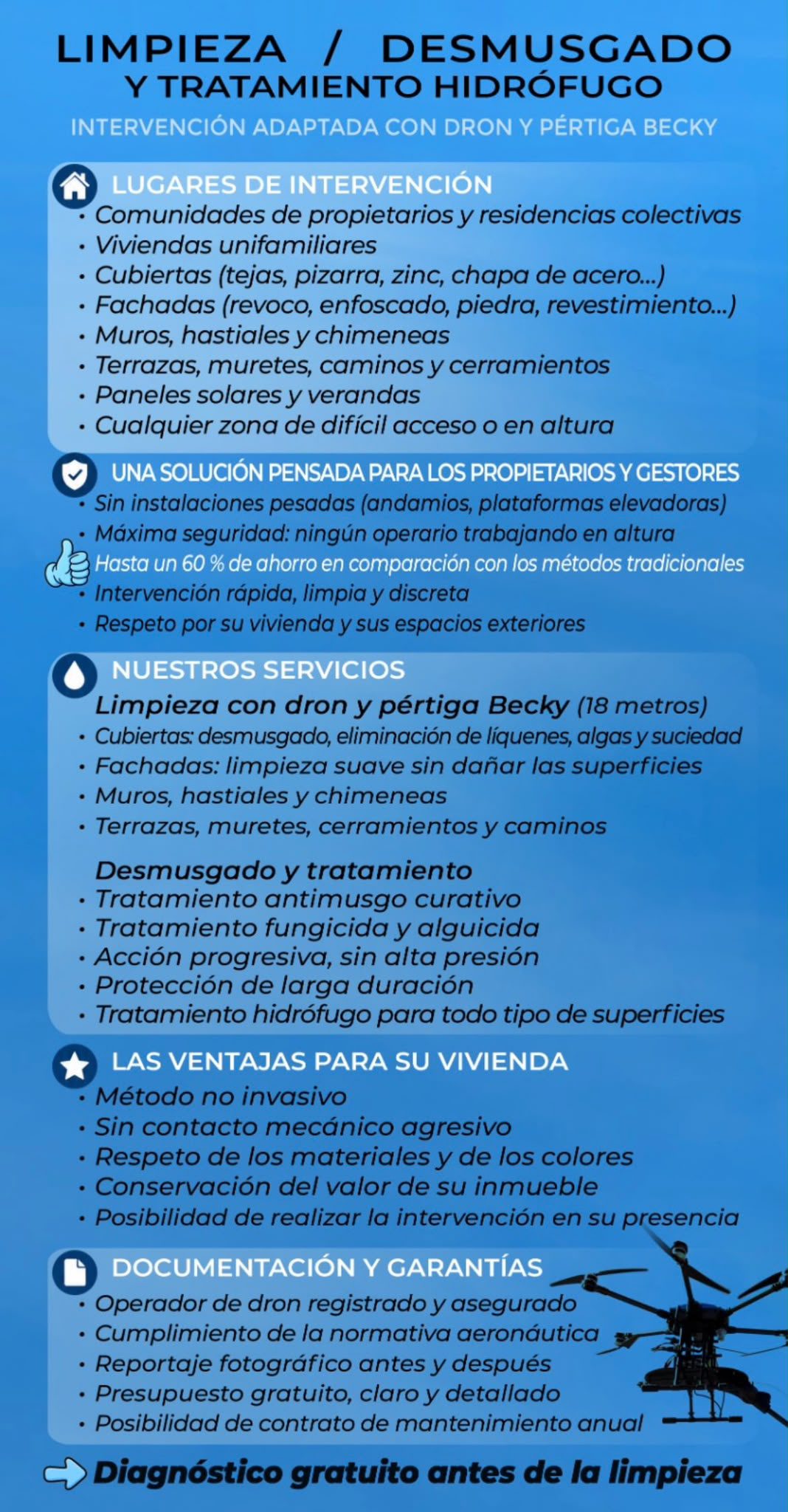
We carry out moss, fungicide and algaecide treatments with a gradual, controlled action, avoiding the systematic use of aggressive high-pressure cleaning. We also apply water-repellent treatments to protect surfaces for longer.
We work on façades, terraces and roofs made of stone, concrete, render, panels, tiles, slate, zinc or sheet metal.
And it isn't all cleaning. Drones also allow us to carry out inspections in areas where conventional access is difficult.
Question Do you see opportunities for collaboration with equipment rental companies?
Yes, absolutely. I think there is a very interesting opportunity.
Rental companies already work with clients who need solutions for work at height, maintenance, cleaning or access to difficult areas. In certain situations, a drone can complement, or even replace, certain traditional equipment.
We are open to exploring agreements with rental companies, Facility Management firms and other professionals so that they can offer this solution to their own clients.
Question What fleet do you currently have?
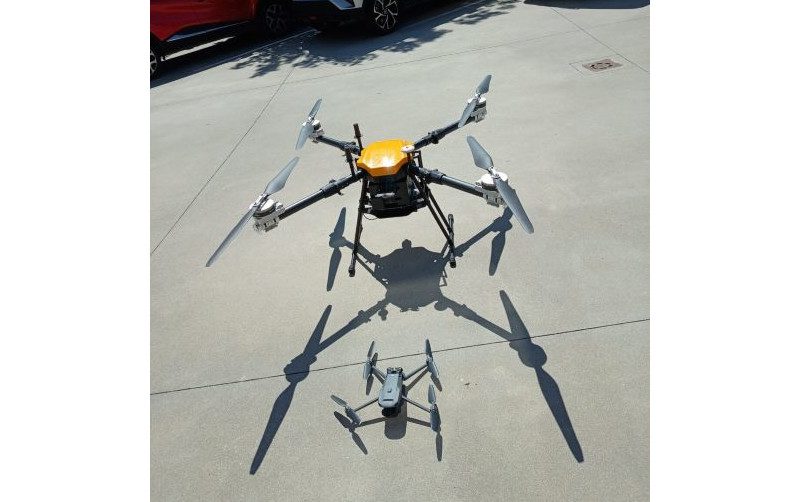
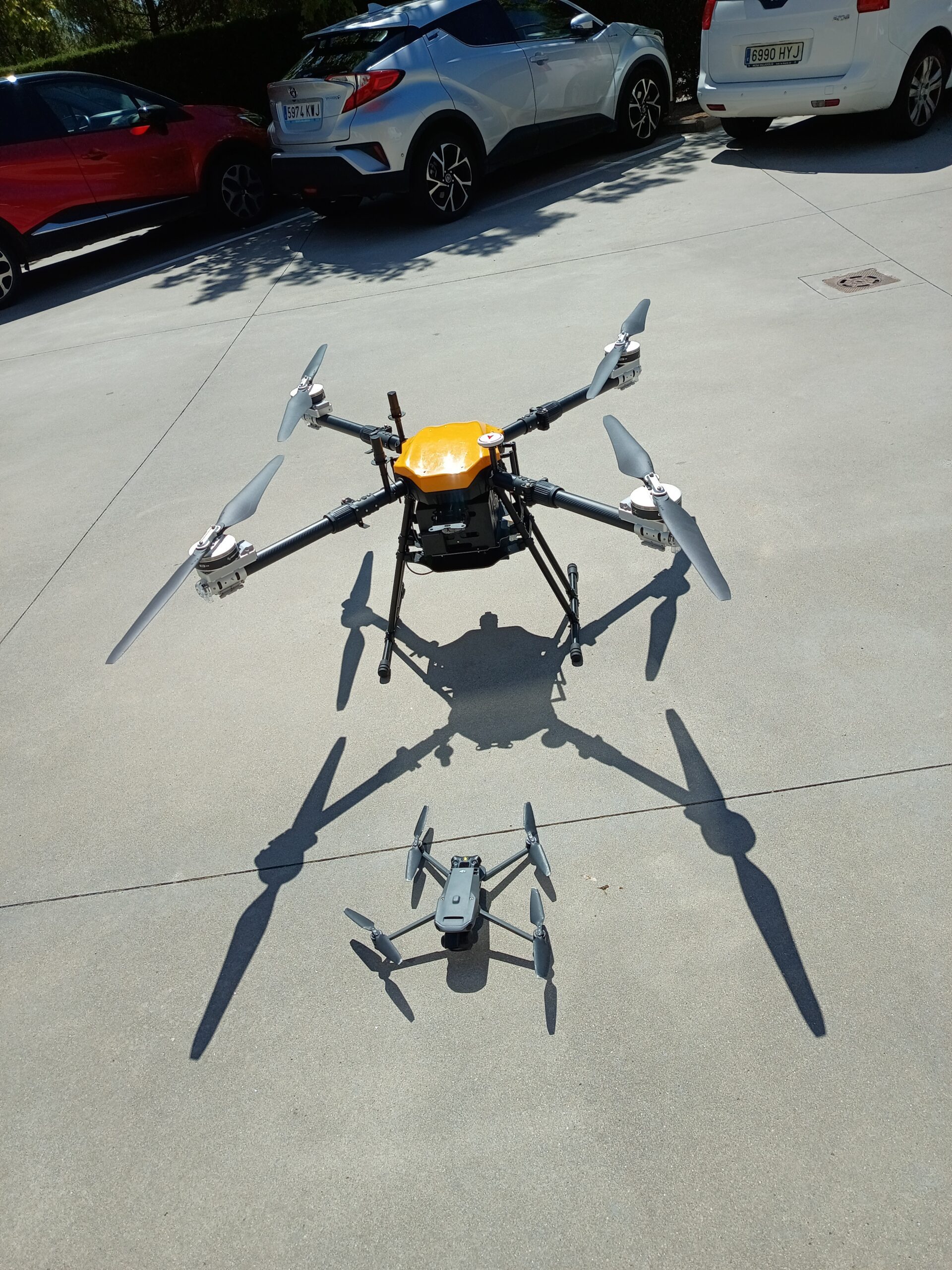
We have two main cleaning drones: the AD410 Spray and the AD420 Spray from Artech'Drone.
We also have telescopic carbon poles of up to 20 metres and, for inspection work, we use specific equipment suited to this type of mission.
Question What are the differences between those two drones?
The AD410 Spray has a payload of up to 10 kg and can work at pressures of up to 160 bar. It is particularly well suited to cleaning and treatment work on different surfaces.
The AD420 Spray has a payload of up to 20 kg and is geared more towards industrial work, large surfaces and very tall buildings.
The choice depends on each job. And here is something important: the drone on its own doesn't do everything. It isn't about flying a machine. It is part of a working system that involves the products, the complementary equipment and, above all, the operator's experience.
For inspection we also use a DJI Mavic 3E RTK.
Question Do you really save time compared with traditional systems?
Yes, although there is no single time that applies to every façade. It depends on the surface, the height, the condition of the façade, the dirt, the material, accessibility and weather conditions.
Where there is a significant difference is in logistics. We don't necessarily need to erect full scaffolding or mobilise the same heavy equipment as with a traditional system.
Preparation can be much faster and, on certain projects, the work can be completed in just a few days.
Question And how high can you work?
There is no height that we can apply to every project. Flight conditions and authorisations depend on each operation.
Besides, not all work at height has to be done with the drone. We have telescopic carbon poles that reach up to 20 metres, and we choose the most suitable system for each situation.
On particularly tall buildings or large industrial facilities, the AD420 Spray allows us to work with greater capacity.
Question Do you rent out the drone, or does the client hire the service directly?
Our activity is mainly focused on the complete service.
It isn't simply a matter of renting a drone. The value lies in having the equipment, a trained operator, the right products, the complementary equipment and the knowledge needed to do the job safely and professionally.
The client hires a solution, not just a machine.
Question And do you sell the equipment?
At the moment we are focused on providing professional services.
We are not simply looking to sell equipment, but to use our experience and our resources to solve a specific need of the client. We take on the operation and the responsibility for carrying out the work.
Question What training does an operator need to do this type of work?
They must have the training and certifications required to operate drones in accordance with the regulations. We hold the A1/A3, A2 and STS categories, as well as specific training related to our work.
But piloting the drone is only part of it. You also have to understand surfaces, materials, the products used, the risks associated with buildings and safety procedures.
My experience as a firefighter has also given me a very important perspective on prevention, risk assessment and safety.
Question Does this equipment require a lot of maintenance?
Maintenance is essential, especially because the equipment works with water, treatment products and spraying systems.
After every operation we carry out checks and clean the equipment, paying particular attention to the spraying system, connections, structure, batteries and any parts that may have come into contact with water or products.
We also carry out regular inspections. In this kind of activity we cannot afford to work with equipment that is not perfectly under control.
Question Safety, time, costs… which would you say is the main advantage over platforms, scaffolding or ropes?
Safety comes first. We considerably reduce the need to expose people to work at height. For me, after 30 years as a firefighter, this is not just a sales argument: it is a conviction.
We also reduce the logistics associated with scaffolding, platforms and other traditional equipment and, depending on the project, the solution can be up to 50% cheaper.
In heritage work there is another important advantage: we can carry out controlled, low-pressure treatments when the substrate requires it, avoiding overly aggressive methods.
In the end, our proposal is based on four principles: technical performance, maximum safety, respect for heritage and cost optimisation.
Question And what happens if it is windy or raining?
If conditions are not suitable, we don't work. It's as simple as that.
Wind, gusts, rain, visibility or the characteristics of the building can directly affect safety.
Technology makes many things possible, but it doesn't remove the need to respect safety conditions. For us, safety always comes before the schedule.
Question Do you want to expand the services you offer?
Yes. We want to keep developing services related to maintenance, inspection and prevention, taking advantage of what drones can do to solve problems that until now required heavier, more costly or more complex equipment.
But we want to do it progressively. It's not about offering a service just because it is technically possible. If a drone is not the right solution for a job, we must also be able to say so.
Question How much does it cost to clean a façade with drones?
We don't have a single price because every project is different.
It depends on the surface, height, type of substrate, level of dirt, products needed, accessibility and any complementary equipment that may be required.
Our goal is not to sell flight hours, but to offer an overall solution in terms of safety, time, quality and cost.
On certain projects, the drone can deliver very significant savings compared with traditional methods, but it would not be serious to give a standard price without first knowing the characteristics of the building.
Question To finish, where do you want to take Marco Solutions Drones?
We want to grow responsibly and establish ourselves as a company specialising in professional cleaning, treatment and inspection solutions using drones.
We also want to build partnerships with equipment rental companies, Facility Management firms and other professionals who can integrate our solutions into their services.
But growth must not come at any price. I am very clear that safety, prevention and a job well done must always come before everything else.
The drone is a modern technology, but it is nothing more than a tool. The real value lies in combining technology, experience, safety and human know-how.
I have been solving problems for thirty years; I'm not about to stop being useful now.
Want to assess your building?
Service across Spain · free technical assessment